

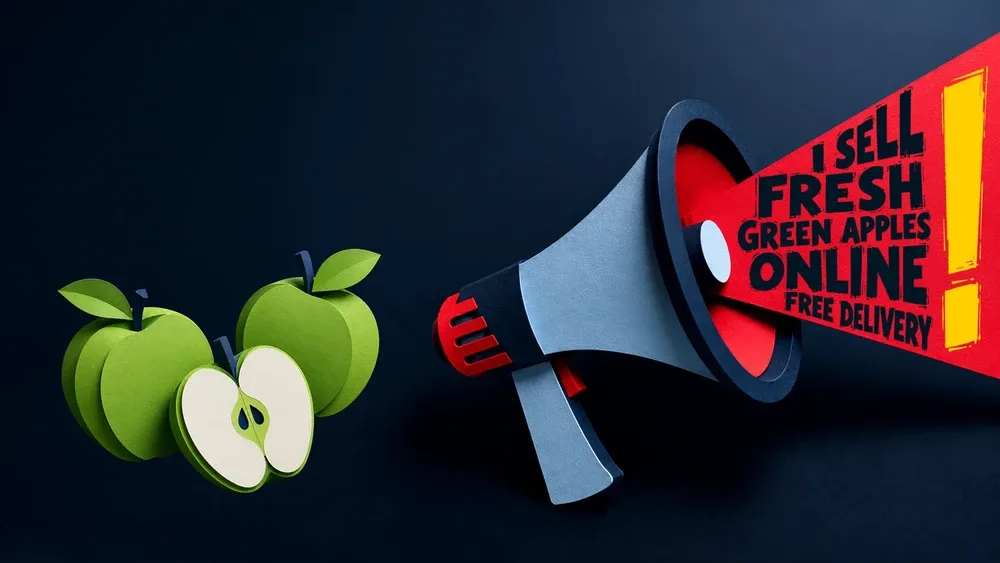
I am going to save you a fortune in product development.
You think you are losing to a better company. You are not. You are losing to a company that is easier to understand. There is a difference, and it is costing you more than you realise.
Here is how it usually goes. Sales dip. Panic sets in. So you do the obvious thing and pour money into the product. You add a feature. You add three. You bolt on a service nobody asked for. You make the good thing you already had slightly more complicated, and then you sit back and wonder why the phone still isn't ringing.
Meanwhile your competitor, whose product is honestly a bit worse than yours, says one clear sentence about what they do and who it is for. And they win.
It feels deeply unfair. It is also completely logical.
A customer cannot judge the quality of your work before they buy it. That is the whole problem. They have not used your service yet. They have not held the thing. They have no idea that your craftsmanship is superior, that your team is sharper, that you sweat the details nobody else bothers with. All of that lives on the other side of a decision they have not made.
What they can judge, instantly, is whether they understand you.
So they choose the company they understand. Not the best one. The clearest one. Quality is something they discover later, if you are lucky enough to get to "later" at all.
We see it constantly. A business spends three years and a serious budget making the actual offering better, and zero minutes making it easier to grasp. They have a brilliant answer welded to a confusing question. Their website opens with a sentence so vague it could belong to a law firm, a logistics company or a yoga retreat. Their "what we do" is a fog of synonyms. And then they are genuinely baffled that the prospect went with the louder, simpler, slightly worse option down the road.
Confusion is not a small tax on your business. It is the whole bill. Every second a customer spends trying to work out what you actually do is a second they are not spending deciding to pay you. And people do not push through confusion. They do not lean in and squint and try harder to understand your value. They leave. Quietly. You never even see them go.
Clarity is not dumbing down, before anyone gets precious about it. It is not making your work shallow. It is doing the harder thing, which is understanding your own value so completely that you can say it simply. Anyone can be complicated. Complicated is easy. Complicated is what you produce when you have not done the thinking yet. Clear is what is left after you have.
This is the part people get backwards. They treat the messaging as the bit you tidy up at the end, the wording you sort out once the "real work" is done. But the message is not the wrapping paper. The message is the product, as far as the customer is concerned, right up until the moment they buy. It is the only version of you they meet first.
So before you spend another cent making the thing better, ask a harder question. Can a stranger tell what you do, who it is for, and why it beats the alternative, in about ten seconds, without you in the room to explain it?
If the answer is no, your product is not your problem. Your silence is. You have built something good and then mumbled about it.
The fix is rarely a better service. It is usually a braver sentence. It is deciding what you are, out loud, and cutting everything that blurs it. It is choosing to be understood over choosing to sound impressive, which are not the same thing and are very often opposites.
Your competitor figured this out. That is the entire trick. They are not smarter than you and their work is not better than yours. They just made the decision to be clear, and you are still hoping people will work it out for themselves.
They won't. They will choose the company that already did the work of being understood.
Make that company you.
Talk to Sorted Design International about saying it clearly.