
Every week there's a fresh headline.
"AI killed web designers."
"AI killed graphic designers."
"AI killed copywriters."
"AI killed photographers."
For a technology that's only a few years old, AI has racked up an impressive body count. Honestly, it should be in jail by now.
The reality is a lot less dramatic.
What AI has actually done is hand average people access to average 'creative' output.
A business owner can now make a logo.
An engineer can now knock together a social post.
A startup founder can now build a basic website.
Good. Truly. Because here's a quiet secret of this industry: the "I can do it myself" person was never the client we wanted anyway. They argue about every line on the quote. They complain. They treat your invoice as a gentle suggestion rather than a thing with a due date. And they don't respect your profession. AI didn't take that client from us. AI gave that client a hobby. We are thrilled for them both.
That's not the end of design.
That's the democratisation of tools.
And we have sat through this exact film before. When the first iMac landed on desks, the same voices swore it was over. Now anyone with a colourful computer and a folder of fonts could call themselves a designer, so surely the profession was finished. It wasn't. The people who only had the machine made flyers with twelve typefaces on them. The people who had the eye carried on being designers. The tool changed. The thinking didn't. AI is just a faster, louder version of that same moment.
Because if AI can make an average person feel like a designer, imagine what it does for an actual Creative.
The whole conversation seems to assume that only non-designers got the upgrade. We were in the room too, Kevin. Everyone else went from non-designer to average designer. We went from designer to something closer to super-maker. Super-thinker. Same brain, bigger engine.
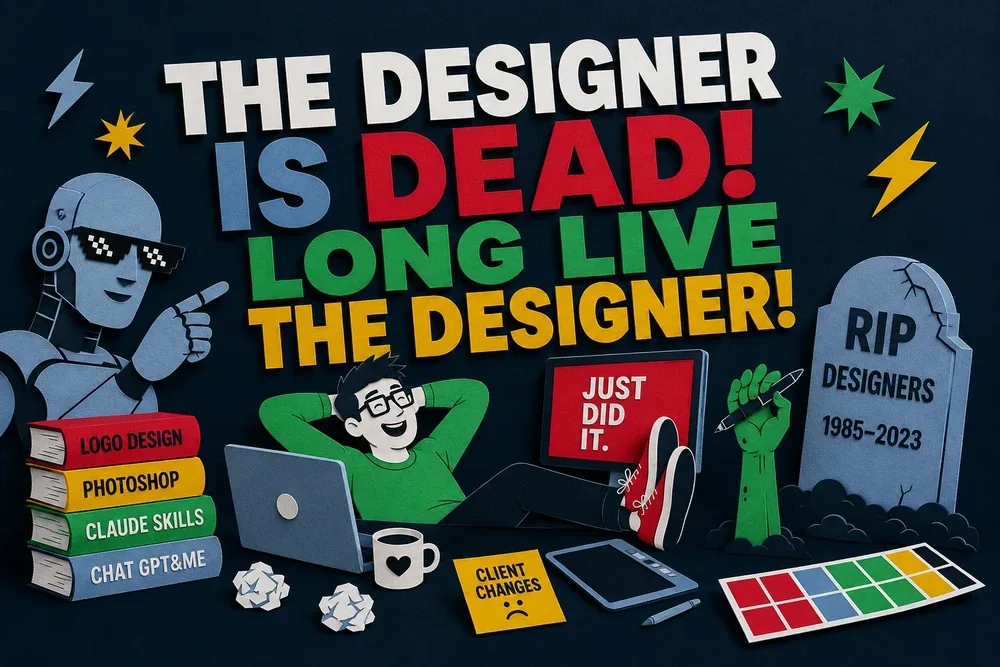
So fine, run the headline if you must. The designer is dead. Long live the designer.
Because the value was never in knowing which button to press.
It was never in removing a background in Photoshop.
It was never in dragging boxes around a screen.
And here is the part everyone keeps getting backwards: we, the designers, were never the tools. We use them. A pencil, a Mac, Photoshop, AI, they are all just things we pick up. The tool has never been the talent. AI is simply the newest thing on the desk, and we will use it exactly the way we have used every tool before it.
The value has always been in the thinking. In seeing the pattern. In connecting two ideas that had no business being together. In understanding people. In knowing why something works, and sometimes not knowing why and just knowing that it does. In feeling.
We're the makers. The creators. The problem-solvers.
AI didn't replace that. It amplified it.
Do I use AI in my work? Absolutely. I'd be an idiot not to.
Do I use it to design for me? Rarely.
Do I use it to help me think? Every single day. That, and a dose of Vyvanse.
I don't know everything. No designer does. But AI has access to an absurd amount of information, perspectives and references, so why on earth wouldn't I tap into that? Not so it can think for me. So it can argue with me.
Sometimes it offers an angle I hadn't considered.
Sometimes it surfaces a reference I'd never seen.
Sometimes it asks the question I should have asked myself an hour ago.
Sometimes it taps into my bias so much that I know I am on the wrong path. Thanks Jung!
It doesn't replace my creativity. It stirs it. It pushes it. It gives me more doors to walk through. That's where the real value sits.
The strange part is that the tasks AI is genuinely best at aren't the creative ones anyway.
It's the copy and pasting. It's laying out a long, deeply boring book and answering the emails that pile up while you do it. It's summarising the meeting, rewriting the notes, cleaning the spreadsheet, and moving data from one place to another while quietly praying nothing breaks on the way.
Nobody was put on this earth to spend half a day copying numbers out of Excel and into an InDesign document. Nobody grew up dreaming of formatting meeting notes. Nobody became a designer because they were passionate about beautifully aligned tables.
So yes, I use AI for that. Paste in the client feedback. Get a draft. Tidy it. Send it. Move on. That's not laziness. That's efficiency. The goal was never to spend more time working. The goal is to spend more time creating.
And this is where I think a lot of people are getting it backwards.
The designers who are scared of AI are usually trying to protect the production part of the job. The execution. The mechanics. The assembly line. But the future value of design was never in production. It's in direction. In taste. In judgement. In strategy. In knowing what not to do.
And AI is still pretty bad at that.
In fact, most AI-made creative work gives itself away instantly. The same dreamy surreal imagery. The same generic compositions. The same over-written copy that never knows when to stop. The same endless feature lists. The same thin line icons. The same "look what AI made" sheen.
Today, designers can spot it in three seconds. Soon everyone else will too, because the novelty is already wearing thin and audiences are getting sharper. People don't connect with work because it was made quickly. They connect with work because someone cared enough to make it mean something.
AI can generate outputs. It can borrow taste, sure, the way you can walk into Weylandts and buy the entire display window exactly as it stands. Lovely room. Costs a fortune. Looks great in the photos. But it isn't yours. You didn't choose any of it. Nobody asked you how it feels. Nobody leaned over and quietly said "that couch is kak, don't buy it." AI will never do that, because AI does not care how you feel. We do. We are the ones who will tell you the truth before you spend the money. The moment you try to add one thing of your own the whole borrowed illusion falls apart. That's the difference. AI can regenerate someone else's taste. It can't generate yours. It can't generate lived experience. It can't generate intuition. It can't generate the thousands of tiny decisions that only come from years of making things, breaking things, fixing things and actually understanding people. That's still the job.
And here's the part I'm genuinely excited about.
For years, the deal was this: a designer has an idea, and then has to translate that idea into something an engineer will accept before anything can get built. And engineers speak their own language, so we were the ones who had to go and learn Klingon, standing there describing a vision in a tongue that was never ours, hoping it survived the round trip more or less intact. It rarely did. And honestly, who could blame them. The engineers were off building spaceships with LED screens on the side, plant-based hard drives and a fridge that does your taxes. They never signed up to make some creative's kak little idea come to life, and they made sure you felt it. Now we can weave creativity straight into the production tools ourselves. We can build the intelligent systems that used to live behind a developer's keyboard. The idea and the making are finally allowed to sit in the same chair. That's not a small shift. That's the whole game changing.
The designers who survive won't be the ones who refuse to use AI. They'll be the ones who learn to use it properly. Not as a replacement. As a multiplier. A thinking partner. A research assistant. A production assistant. A force multiplier for human creativity.
The future isn't AI versus designers.
The future is designers versus themselves. Are you going to upskill the sh!t out of this, or are you going to sit in the corner playing with your letterpress and telling everyone how it used to be?
Play with the letterpress on a Sunday. By all means. But on Monday, pick the new tool up.
And that's a very different conversation.
So, did I use AI to write this post?
Yes. Obviously. Proudly. Anyone who knows me knows how kak my English is, so the fact that you've read this far without wincing is frankly a collaboration we should all be grateful for.
Did AI give me the idea to write it?
No, sir. That credit goes entirely to a certain very confident American and his weekly "AI JUST KILLED..." posts. So if anyone deserves a thank you here, it's him. He gave me the angle. I just had the distaste to use it.